People often talk about social innovation in broad, abstract terms: systems change, global disruption, the Sustainable Development Goals, climate resilience, circular economies, social mobility, workforce development, and equity.
But economic growth and impact are not abstract; they are tangible, and they start locally.
The Charles D. Close School of Entrepreneurship at Drexel University’s LeBow College of Business serves as a hub for entrepreneurial education, known for fostering entrepreneurs and connecting with regional innovation networks. We are also actively involved in Philadelphia’s sustainable business community, a role that is less widely recognized. Our students collaborate directly with the community, gaining hands-on experience that deepens their understanding of local economic dynamics. Through our curricular and co-curricular programs, they engage with leaders across Philadelphia’s sustainable business sector and gain exposure to initiatives addressing social and environmental challenges, sometimes contributing through real-world projects.
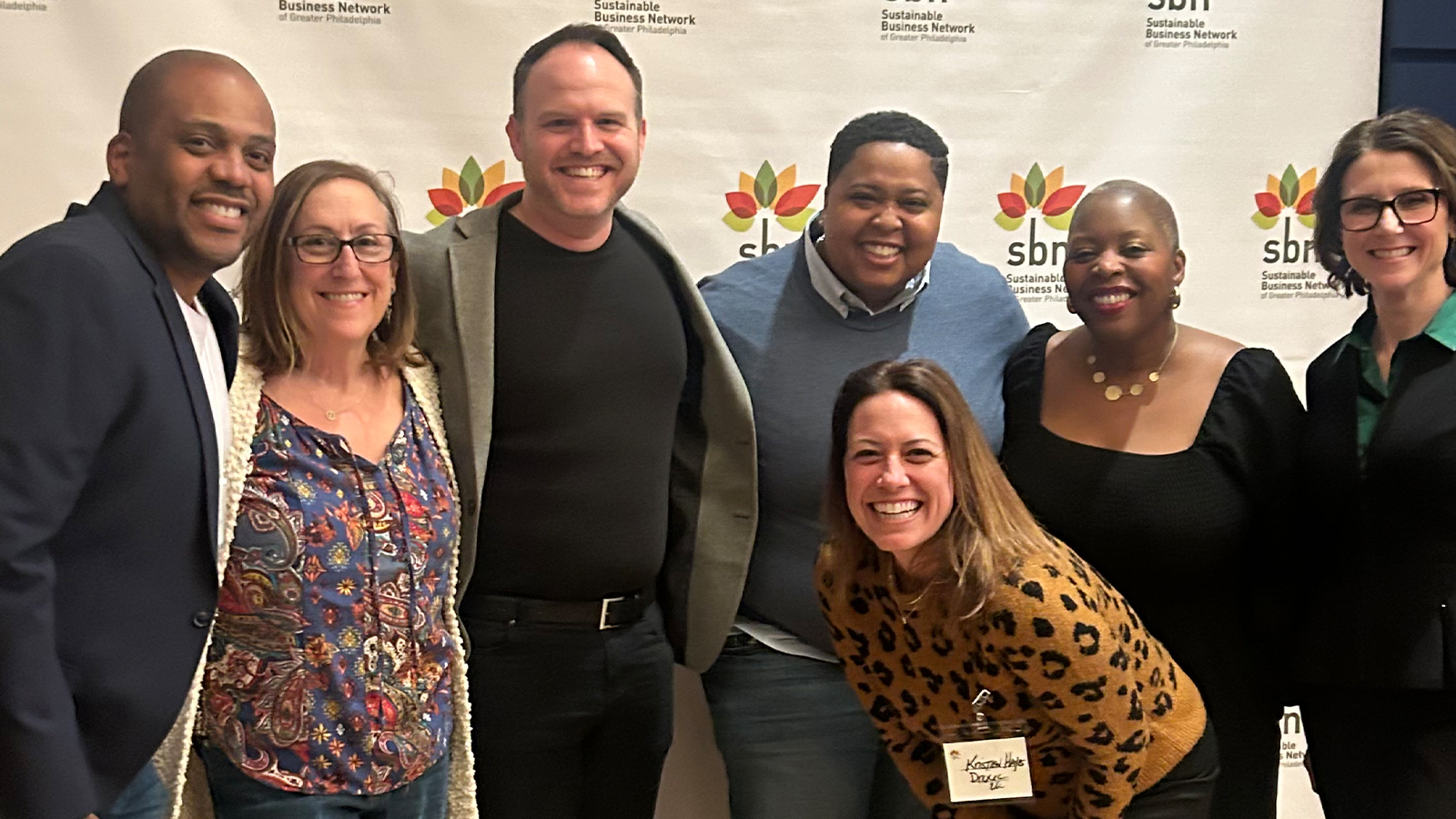
Our embeddedness is evident in our ongoing involvement with organizations that shape Philadelphia’s economy and sustainability efforts. Through our membership in the Sustainable Business Network of Greater Philadelphia (SBN) and our annual participation in SustainPHL, a key regional gathering, our students gain direct exposure to business leaders, nonprofit innovators, and civic changemakers shaping the region. These are not secondary experiences; they are integral to how our students begin to understand and engage with the ecosystem in which they operate.
It is within this ecosystem that our faculty and staff design courses and co-curricular experiences that draw directly from the local economy and the leaders shaping it.
For example, in Early-Stage Venture Funding, our students learn where capital comes from in the earliest stages of a venture. Before institutional capital, ventures are often financed by founders themselves and those who know them best: family, friends, and local networks willing to invest based on trust as much as traction. These decisions are not abstract; they are rooted in relationships, reputation, and accountability within a community. Recognizing that reality underscores a core principle of our approach: capital formation starts locally, long before it scales.
That perspective is reinforced through the practitioners who teach in the program. Dr. Tia Lyles-Williams, a biotechnology executive who co-teaches the Early-Stage course with Professor Rob Morier, exemplifies the caliber of leader engaging with our students. As CEO of LucasPye BIO and HelaPlex, her work sits at the intersection of biotechnology manufacturing, capital formation, and economic development, with a focus on expanding opportunity and rebuilding the American middle class, particularly in minority and distressed communities.
That same focus on local context extends beyond capital formation to include how our students apply entrepreneurial thinking in their communities and neighborhoods. Professor Scott Quitel’s community-based learning initiatives in Logan, his Green Start course, and his work through the Land Health Institute demonstrate how entrepreneurial thinking can be applied to community design, environmental resilience, and civic engagement. These efforts reinforce the same principles that guide the broader ecosystem: build capacity where you are.
In courses like ENTP 375 Triple Bottom Line Entrepreneurship and ENTP 601 Social and Sustainable Innovation, this core principle is emphasized. We encourage students to think ambitiously but start with small, manageable steps. SDG-focused projects should first pilot locally by answering two questions: How does this benefit the local economy? How does it serve the community?
The Impact Innovation Hub (IIH) is a university-wide co-curricular initiative housed in the Close School that builds on this emphasis on local, applied work through a more selective, intensive, six-month cohort model.
Participants develop ventures across industries and sectors, shaping early-stage ideas into clearly defined business models, value propositions, and compelling pitches through mentorship, a structured program called the Impact Entrepreneurs Bootcamp, disciplined feedback, and, where appropriate, the development of early prototypes or minimum viable products.
This year’s cohort included three undergraduate and two graduate students from the College of Engineering, the College of Computing and Informatics, the School of Biomedical Engineering, Science, and Health Systems, and the Close School.
The Impact Entrepreneurs Bootcamp is led by Angela Vendetti, a Drexel alumna and founder of Mugshots Coffeehouse, a mission-driven business built on fair-trade sourcing, local procurement, and Farm-to-Office catering, which she scaled to five locations and more than $2 million in annual revenue. Mugshots was a founding B Corporation, part of a global movement using business as a force for good, and her work established her as a leader in Philadelphia’s sustainable business community. She designed the program and serves as the primary mentor to participating students.
Our students carry those ventures into competitions such as Startup Fest and the Hult Prize, both of which are integrated into the Impact Innovation Hub while remaining open to broader student participation.
Startup Fest reinforces this integration. This year’s theme, Innovation and Impact, reflected our expertise in social and sustainable innovation. Impact-driven ventures received preferential scoring in the Fast Pitch Competition. Our students presented at the Proving Ground Expo, and finalists competed for up to $20,000 in the Drexel Startups Fund competition. The keynote speaker, Robert Amar of Small World Seafood, demonstrated how a neighborhood-rooted enterprise can strengthen local supply chains and community ties while building a viable business.
The Hult Prize competition extends that framework. As the world’s largest impact-focused student pitch competition, it challenges students to build for-profit enterprises aligned with the Sustainable Development Goals. We hosted a regional Hult Prize competition, bringing together student teams from Drexel, Temple, and Rowan, grounding a global challenge in local accountability and demonstrating our commitment to supporting the regional entrepreneurial ecosystem.
Judges drawn from Philadelphia’s innovative and sustainable business ecosystem bring real expectations shaped by operating in this city’s economy. They include Mike Pearson, President and CEO of Public Health Management Corporation and former founder and CEO of Union Packaging; Bo Zhao, founder and CEO of Baby Gear Group, a Philadelphia-based circular economy venture recognized as one of TIME’s Best Inventions of 2025 and a certified B Corporation; and Jenn Richey Nicholas, founder and CEO of Pixel Parlor, a B Corp-certified branding and design studio. We are all connected through SBN as board members or long-time participants, reinforcing the depth and continuity of the network our students engage with.
Through sustained engagement with organizations like SBN and SustainPHL, our students develop relationships with business owners, ecosystem builders, and institutional leaders whose decisions influence funding, supplier relationships, and regional growth. They share their ideas with the local community, where these ideas are shaped and refined before any broader expansion is considered. As they move through this process, our students are not just observing the ecosystem; they are learning within it, gaining repeated exposure to the people, expectations, and realities that determine how ventures truly take root and grow.
Founders serve as judges, keynote speakers, or workshop hosts. Executives mentor students or provide co-op positions. Banks and businesses sponsor pitch competition prize money and other event-related expenses. One of our graduate students, Drexel’s Executive Director of Supplier Initiatives and Relationships, Allen Riddick, has integrated what he learned in ENTP 601 into his work, strengthening supplier diversity initiatives and advancing the integration of local, sustainable businesses into Drexel’s procurement strategy. His work reflects the kind of alignment this ecosystem makes possible, where learning, professional practice, and community engagement reinforce one another. He is actively engaged in the local ecosystem beyond the classroom, including at SBN and B Local Philly, a community of Certified B Corporations working to drive positive social and environmental impact.
We are not simply teaching entrepreneurship. We are embedding entrepreneurial education within regional systems that create economic opportunity and social change. The Impact Innovation Hub is a visible expression of that commitment.
If the goal is to advance meaningful impact, then the work must begin locally.
Think big. Start local.
That is where impact starts. That is the work we are doing at the Close School.