
When Theo Young ’28 entered his second year at Drexel University, he knew he wanted to build something of his own. What he did not know was that the initial concept he started with would look radically different two years later.
Now a fourth-year entrepreneurship major (as part of a 5-year program) at the Charles D. Close School of Entrepreneurship, Young has successfully navigated the iterative process of venture creation. He recently completed Drexel’s signature Entrepreneurship Co-op – a six-month program providing student founders with dedicated incubator space, faculty mentorship and a $19,000 scholarship to focus full-time on building their startups.
Through that full-time commitment, Young built and launched Prop Archive, an all-in-one land and property management software designed to give independent landlords the sophisticated tools typically reserved for enterprise real estate firms.
For Young, the motivation was personal. Having grown up around family members involved in real estate, he saw firsthand the operational confusion and administrative friction small property owners confront daily.
“When I tried to get into real estate, I found that the original problem I was trying to solve didn’t line up with what customers actually needed,” Young says. “So I pivoted. I started working on a direct problem for small landlords, hoping to fix it for them.”
Unlike traditional co-op placements, the Entrepreneurship Co-op required Young to act as both chief software architect and primary operator. He engineered the entire Prop Archive platform himself while balancing continuous customer discovery, platform uptime monitoring and weekly advising sessions.
The intensity of operating a standalone software venture yielded rapid market validation. Within a month during his co-op, Young brought five active beta users onto the platform and drove over 2,800 unique visitors to Prop Archive.
“The hardest part was handling the emotional ups and downs that come with managing a business,” Young reflects. “Time management can be tricky, but you just have to persevere and keep pushing.”
Throughout his co-op, Young anchored his operations at the Baiada Institute for Entrepreneurship, the Close School’s campus incubator. Working alongside a peer cohort of student founders building everything from physical products to specialized software created a high-performing, collaborative environment.
“Being up in Baiada has been an amazing experience,” Young says. “Having a room full of like-minded people all trying to build a company really turns into a cultivating space that helps you mature your idea and grow it from the ground up.”
Beyond the incubator footprint, Young points to the Close School curriculum and faculty accessibility as essential support systems for solving real-time operational bottlenecks.
“Having the framework from entrepreneurship classes is an amazing tool to have in your back pocket,” Young notes. “There are times when I get stuck, and then I realize that a piece of homework from a class three years ago had the exact framework I needed in that moment to move forward.”
He also credits the broader entrepreneurship ecosystem on campus – including Startup Fest, Future Fest and The Proving Ground – with exposing him to growth-building, high-stakes venture presentations where founders compete for upwards of $50,000 in capital while improving their pitches.
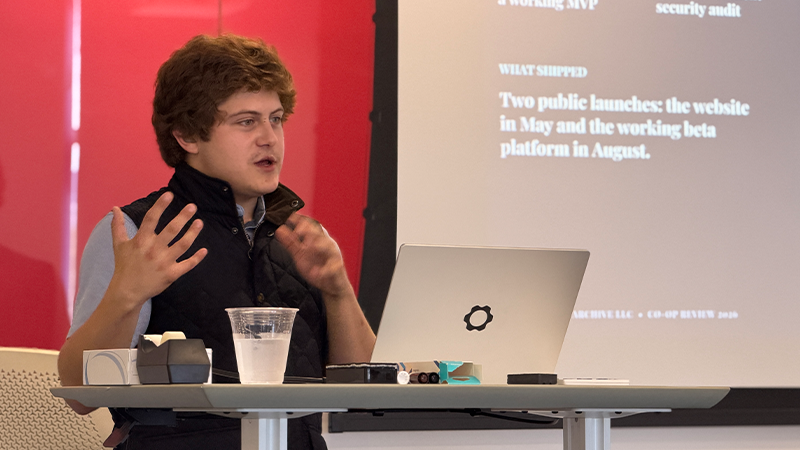
Those experiences culminated in his final co-op presentation before a panel of advisors and peers, marking the completion of his six-month venture build.
“Gearing up for the presentation, I was extremely nervous,” Young admits. “But when it was done, I felt super accomplished. I felt like I had hit a mark I’d always wanted to hit – that I completed a goal, started my own company and survived those six months.”
Now, back in the classroom balancing a 17-credit course load alongside ongoing customer onboarding, Young remains focused on scaling Prop Archive and expanding its beta testing group. His advice for fellow Drexel students sitting on early-stage ideas is simple: do not let fear prevent the first step.
“It really is just about diving in and getting going,” Young says. “I started in my second year with something completely different from what I have now. I kept pivoting and persevering. Don’t let things get in your way, keep working and things will work out the way you want them to.”


